ProfitGuru Private Label Product Research Guide for Beginners
ProfitGuru can help private-label sellers find products, check demand, study competitors, research keywords and validate a niche. The safe workflow is to use Product Database for candidates, Market Intelligence for niche structure, Reverse ASIN for keywords and external checks for history, costs, intellectual property and supplier feasibility.
The goal is not to find a product with impressive numbers. It is to reject weak ideas before spending money on samples and inventory.
Start with a product thesis
Write down the kind of opportunity you want before using filters. A useful thesis includes:
- Target selling-price range
- Maximum size and weight
- Minimum demand
- Maximum review barrier
- Target landed-cost percentage
- Acceptable seasonality
- Categories you understand
- Products or claims you will avoid
Without a thesis, sellers keep adjusting filters until an exciting result appears. That is confirmation bias, not research.
Step 1: Build a candidate list
Use Product Database to filter popular products by demand, price, rank, reviews, competition and physical characteristics. ProfitGuru currently limits Starter to 50 results per search; Professional provides unlimited results.
Keep the first list broad enough to compare ideas, but do not save hundreds. Ten to twenty candidates are easier to investigate properly.
For each candidate, record:
- ASIN and primary keyword
- Current price
- Bought Past Month range
- Estimated sales and BSR
- Reviews and rating
- Seller and brand concentration
- Size and weight
- Initial improvement idea
Step 2: Validate demand across time
Current sales estimates are only a snapshot. Inspect historical BSR and price patterns through Keepa charts or another reliable source.
Strong demand normally shows repeated rank movement and a stable market over time. Red flags include:
- One short seasonal spike
- Current stock-outs among leaders
- A temporary viral trend
- Falling price with rising seller count
- Demand concentrated around gifting weeks
Use Bought Past Month as another signal, not as an exact forecast.
Step 3: Understand the market, not one product
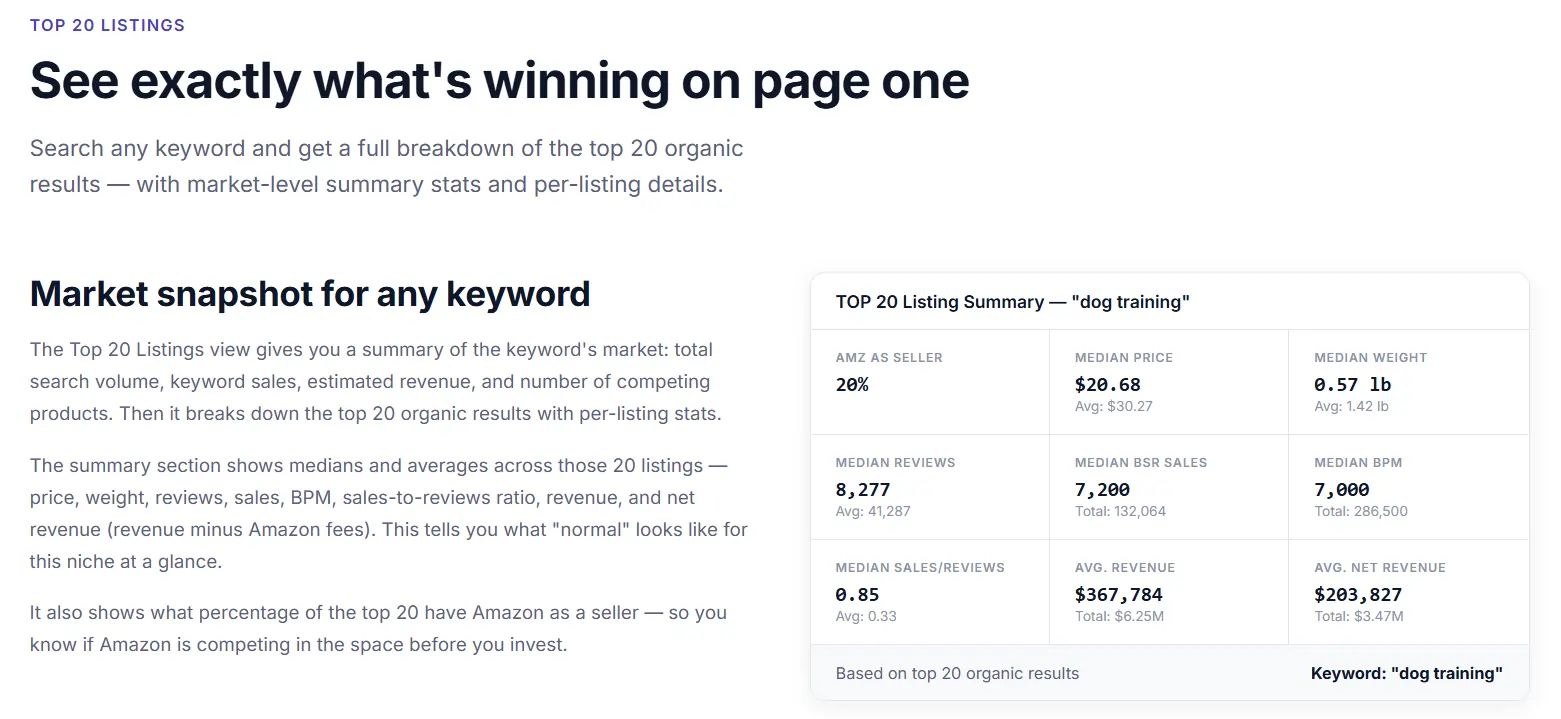
ProfitGuru Professional includes Market Intelligence. Start with a keyword or explore popular terms by category, then examine search volume, trend, competition and title density.
Review the top organic listings as a group:
- How much revenue is concentrated in the top three?
- Does one brand control the page?
- Are review counts reachable?
- Are prices stable enough for your margin?
- Do most products share the same design?
- Does Amazon sell a competing item?
A niche with demand can still be unattractive when established brands control trust and advertising costs.
Step 4: Run Reverse ASIN research
Select several relevant competitors rather than copying one market leader. Reverse ASIN can reveal common and unique search terms, volume trends and related opportunities.
Group keywords by intent:
- Core product terms
- Material or feature terms
- Use-case terms
- Audience terms
- Size, count or compatibility terms
- Problem-led searches
This keyword map helps estimate whether demand is broad and whether the proposed product has a clear positioning angle.
Starter allows five Reverse ASIN lookups daily. Professional provides unlimited lookups under current pricing.
Step 5: Find a real quality gap
A quality gap is not “make it better.” It is a specific, repeated customer problem that can be solved without destroying margins.
Read recent critical reviews across multiple competitors. Tag complaints such as:
- Breaks at one component
- Difficult assembly
- Misleading size
- Poor instructions
- Leaking or weak packaging
- Missing accessory
- Material odour
- Incompatibility
Then test feasibility. A thicker material may increase dimensional weight. An extra accessory may create safety testing or patent risk. Better packaging may raise landed cost.
ProfitGuru’s AI or quality-gap signals can help organise evidence, but human review must confirm that the complaint is recent, common and solvable.
Step 6: Calculate realistic economics
Estimate:
- Factory unit cost
- Packaging
- Inspection
- Freight, duties and brokerage
- Amazon referral and FBA fees
- Storage
- Returns and damage
- Coupons and promotions
- PPC launch cost
- Software and overhead
Run three selling-price scenarios: current average, 10% lower and a stressed price based on historical lows. If the product fails under modest pressure, the margin is fragile.
Use ProfitGuru’s FBA Calculator for an initial view, then confirm major fees with Amazon’s current calculator and your freight quote.
Step 7: Check competition quality
Review more than review counts. Inspect:
- Image and video quality
- A+ Content
- Brand Store presence
- Listing copy and keyword coverage
- Sponsored placement density
- Variation strategy
- Recent review velocity
- External brand recognition
A page full of weak listings can indicate opportunity. It can also indicate low buyer interest. Demand data must support the interpretation.
Step 8: Check legal and operational risk
Before contacting factories or ordering samples:
- Search relevant patents and trademarks
- Avoid copying protected designs or packaging
- Check product-safety and labelling rules
- Confirm Amazon category requirements
- Assess dangerous-goods, battery and children’s-product rules
- Estimate return and defect exposure
- Check whether the product is easy to inspect consistently
No research platform replaces qualified legal or compliance advice.
Step 9: Score the opportunity
Use a simple 100-point model:
| Factor | Points |
|---|---|
| Demand stability | 20 |
| Margin under stressed price | 20 |
| Competition and review barrier | 15 |
| Solvable customer gap | 15 |
| Keyword breadth | 10 |
| Manufacturing simplicity | 10 |
| Compliance and IP risk | 10 |
Set a minimum score before research begins. A high score does not mandate a launch; it determines which ideas deserve samples and supplier quotes.
Step 10: Run a go/no-go review
The final decision should answer:
- What evidence proves stable demand?
- Why will the product earn clicks and conversion?
- What is the margin after realistic PPC?
- Which competitor advantage is hardest to overcome?
- What would make us cancel after samples?
- How much cash remains after the first order and launch?
Write a one-page decision memo. This prevents enthusiasm from rewriting the evidence.
Which ProfitGuru plan is best for private label?
Starter can find and investigate a small number of ideas. Professional is better for serious private-label research because it unlocks Market Intelligence, unlimited Product Database results, unlimited Reverse ASIN and Suggested Keywords, 1,000 tracked keywords and exports.
The Professional list price is $50 monthly. Code AMZNINJA50OFF advertises a 50% reduction, which calculates to $25 for the discounted monthly charge (AFFMAVEN30 gives 30%, or $35). Confirm the final and renewal amounts at checkout. See the complete pricing guide.
Common beginner mistakes
- Choosing a product because monthly revenue looks high
- Ignoring review and brand concentration
- Using today’s price instead of historical lows
- Treating estimated sales as exact
- Copying a competitor rather than solving a complaint
- Forgetting freight, PPC and returns
- Ordering inventory before IP and compliance checks
- Choosing a huge niche when cash supports only a small launch
Write the research memo
Before ordering samples, create a memo another seller can challenge. Include the primary keyword, demand history, leading competitors, review barrier, customer complaints, proposed difference, landed-cost range, stressed margin, PPC assumption and IP or compliance risks.
Add a “reasons not to launch” section. If the memo contains only upside, the research is incomplete. Update it after supplier quotes and samples. A product may pass market research but fail because the improvement is expensive, quality is inconsistent or packaging changes the fulfilment tier.
Final verdict
Verdict
ProfitGuru gives beginners a coherent research path without the price of a large all-in-one suite. Professional is the more capable private-label plan because Market Intelligence and unlimited keyword research change the quality of niche validation.
The software should be used to disprove ideas. When an opportunity survives demand history, competition, cost, keyword, customer, IP and compliance checks, it has earned the next step: supplier quotes and samples.
Frequently asked questions
Can ProfitGuru find private-label products?
Yes. Product Database can produce candidates, while Professional adds Market Intelligence and expanded keyword research for validation.
Does ProfitGuru show exact Amazon sales?
No third-party research platform knows every competitor’s exact sales. Use estimates as directional evidence and check history.
Is Starter enough for private-label research?
It is enough for light research. Professional is better for repeated niche validation because it includes Market Intelligence and higher limits.
Does ProfitGuru replace Keepa?
It can display Keepa charts in its extension, but sellers needing advanced historical functions may still use Keepa separately.